Showing posts sorted by date for query network centrality:. Sort by relevance Show all posts

Monday, December 14, 2009

Web science, Webwhompers

I have just unveiled Webwhompers, which bears the fruit of four years of my teaching Web science at Boston University. The site features a few interests of mine:
  • A solid layman's introduction to Web science, focusing on the intersection of mathematics, sociology, and the Web as it is used and built by regular people. It is all presented as an online textbook you can read here.
  • A case study in educational methodology. Unlike the online textbook, which is meant to be read, the rest of Webwhompers is meant to be experienced. It provides the online portion of my answer to the question, "What can 70 non-technical college students do together in 12 weeks that will result in their learning as much as possible about the Web?"
The course mission statement puts it this way:

Technology is often created by "experts" and then used by "regular people." Webwhompers celebrates the "Web builder": a regular person who creates his own Web technology.

Sometimes it helps to distinguish between "regular people" who use technology and "experts" who create technology. For example, a regular person might want a home stereo; he pays experts to create hi-fi technology for him. In other cases, regular people create technology without even considering asking for expert help—for example, making a snowball.

Much of the Web technology that regular people want is within their power to create, just like a snowball. Webwhompers seeks to unleash the technical creativity of the regular person: By highlighting Web building resources, by bringing together aspiring Web builders, by providing expert guidance when necessary, and by encouraging regular people to try on the idea that they can create their own Web technology.

The course overview puts it this way:

Our course introduces Web science. It has no prerequisites and has been used by non-technical undergraduates at Boston University since 2006. Our curriculum is guided by the following passage adapted from "Web Science: An Interdisciplinary Approach to understanding the Web," by James Hendler, Nigel Shadbolt, Wendy Hall, and Tim Berners-Lee:
Web science, an emerging interdisciplinary field, takes the Web as its primary object of study. This study incorporates both the social interactions enabled by the Web's design and the applications that support them.

The Web is often studied at the micro scale, as an infrastructure of protocols, programming languages, and applications. However, it is the interaction of human beings creating, linking, and consuming information that generates the Web's behavior as emergent properties at the macro scale. These properties often generate surprising properties that require new analytic methods to be understood.

For example, when Mosaic, the first popular Web browser, was released publicly in 1992, the number of users quickly grew by several orders of magnitude, with more than a million downloads in the first year. The wide deployment of Mosaic led to a need for a way to find relevant material on the growing Web, and thus search became an important application, and later an industry, in its own right. The enormous success of search engines has inevitably yielded techniques to game the algorithms (an unexpected result) to improve search rank, leading, in turn, to the development of better search technologies to defeat the gaming. More recent macro-scale examples include photo-sharing on Flickr, video-uploading on YouTube, and social-networking sites like mySpace and Facebook.

The essence of Web science is to understand how to design systems to produce the effects we want. The best we can do today is design and build in the micro, hoping for the best; but how do we know if we've built in the right functionality to ensure the desired macro-scale effects? How do we predict other side effects and the emergent properties of the macro? Further, as the success or failure of a particular Web technology may involve aspects of social interaction among users, understanding the Web requires more than a simple analysis of technological issues but also of the social dynamic of perhaps millions of users.

Given the breadth of the Web and its inherently multi-user (social) nature, its science is necessarily interdisciplinary, involving at least mathematics, computer science, sociology, psychology, and economics.

Four important themes of Web Science are
  • Micro: an individual acts
  • Macro: the world responds (or not) to an individual's action
  • Synthetic: something is created to produce a desired result
  • Analytic: laws are stated to explain observed phenomena

We focus on these themes as they apply to Web builders -- people who contribute links and other content to the Web:


Synthetic
Analytic
Micro
An individual builds a Web
site to produce a desired result.
(We do not speak
to this quadrant.)

Macro
"The world" builds a Web site
to produce a desired result
.
Laws are stated to explain
large-scale Web phenomena.

Some Web builders consider themselves Web developers; others consider themselves bloggers; others merely post an occasional comment on someone else's blog or discussion forum. We say "Web builder" to encompass the full spectrum of people who contribute links and other content to the Web.

Our lab curriculum provides an informal hands-on approach to the task of building a Web site. Our Search and Share pages help Web builders leverage collectively engineered resources (such as WordPress). The formal chapters of the Study page (which you are now reading) explain large scale Web phenomena; they also explain the Amazon recommendation algorithm and the Google PageRank algorithm.

The sociology, psychology, and economics of this course follow Duncan Watts' Six Degrees, which we recommend as a narrative companion to our own material. Our complete suggested reading list is below.

Online safety

Protecting yourself from evildoers

Privacy, trust, and ownership

Networks

Basic mathematical foundations of networks:

Set Theory

  • Sets
  • Explicit Notation for Sets
  • Cardinality
  • Subsets
  • Venn Diagrams
  • Union and Intersection
  • Ordered Lists
  • Implicit Notation for Sets
  • Logical Expressions
  • Compound expressions with "or"
  • Compound expressions with "and"
  • Union and intersection defined formally
  • Similarity of Sets

Graph Theory

  • Graphs
  • Undirected and Directed
  • Neighborhood and Degree
  • Density and Average Degree
  • Paths
  • Paths in undirected graphs defined formally
  • Paths in directed graphs
  • Length
  • Distance

See also Facebook and Touchgraph

Network Structure

Hubs, clusters, and other basic structural features of the Web:

Network Structure

  • Connected: a word of many meanings
  • Induced Subgraphs
  • "Connected" defined formally
  • Connected graphs and connected components
  • Hubs
  • Clusters
  • Defining clusters, part one: connected components
  • Defining clusters, part two: cliques
  • Defining clusters, part three

See also:

Network Dynamics

How randomness, homophily, and cumulative advantage shape the Web:

Network Dynamics

  • Limitations of traditional graph theory
  • Introduction to network dynamics
  • Three models of dynamic graphs
  • Random graphs
  • Demonstration of random graph dynamics
  • Random graph algorithm
  • Clusters and homophily
  • Triadic closure
  • Triadic closure algorithm
  • Hubs and cumulative advantage
  • Preferential attachment algorithm

See also:

All the above are summarized in the following table:

Random graphs
Clustering
Centrality
Real-world phenomenon explained by model
Giant component forms quickly when |E| ≅ |V|.
Clusters emerge, providing "table of contents" overview.
Hubs emerge, indicating popularity and/or influence.
Web sites
N/A
Clusty, iBoogie, Grokker
Google et al
Sociological force
Chance
Homophily
Cumulative advantage
Mathematical model
Random graph algorithm
Triadic closure algorithm
Preferential attachment algorithm
Variables, Probability, and Scale-Free Networks

Understanding that the Web is a scale-free network requires some probability theory:

Variables and Probability

  • Variables in mathematics
  • Variables in algorithms
  • Random variables
  • Discrete vs. continuous variables
  • Probability distributions
  • Degree distributions

General discussion of scale-free networks:

  • Six Degrees Chapter 4, pp 101-114
  • From previous chapter on Network Dynamics
    • Hubs and cumulative advantage
    • Preferential attachment algorithm
Information and Computation

Applying fundamental concepts of computer science to the Web

Information and computation

  • Information, computation, and algorithms
  • Summation: an example of what computation is
  • HTML: an example of what computation is not
  • Computing distance, part one: Information diffusion
  • Computing distance, part two: Example
  • Computing distance, part three: Algorithm

Examples of information diffusion on the Web:

See also:

Collaborative Filtering

How to compute personalized recommendations:

Collaborative Filtering

  • "Expert opinions" without the experts
  • Delicious: example of CF
  • Bookmarks: content of Delicious
  • Tuples: content of CF
  • Bipartite graphs: structure of CF
  • Structural equivalence: computation of CF
  • Delicious: algorithmic summary
  • The four steps of collaborative filtering
The Long Tail

Niches and blockbusters in the world of Web commerce:

The Long Tail

  • Macro-analytic view of collaborative filtering
  • Power law revisited
  • Niches, megahits, and the neglected middle
  • Macro-analytic view of the long tail
  • Macro view of Web programming

See also:

  • The Long Tail, by Chris Anderson. Wired, October 2004.
  • Going Long, by John Cassidy. The New Yorker, July 2006.
  • Six Degrees Chapter 7, pp 207-215: Information Externalities & Market Externalities
Influence in Networks

How to compute the influence of a Web page:

Influence in Networks

  • Popularity, influence, and centrality
  • Introduction to PageRank
  • NetRank: a simplified version of PageRank
  • Normalization and convergence
  • The NetRank algorithm
  • Dividing by outdegree: the NR* formula
  • The PageRank formula
  • The damping factor: PageRank as probability

See also PageRank Explained by Phil Craven

Competition and Cooperation

What happens when Web builders seek to increase their influence?

Games: Competition and Cooperation

  • Dynamics of popularity and influence
  • PageRank competition
  • Doing the right thing
  • Mutually assured construction
  • Authority, reciprocity, reputation
  • Game theory
  • Winners' dilemma

See also

This work is licensed under a Creative Commons Attribution-ShareAlike 3.0 License and is copyrighted (c) 2009 by Connective Associates LLC except where otherwise noted.

Thursday, August 27, 2009

Influence and social capital of 21st century leaders

My previous post summarized "four fundamentals of networks" with special emphasis on the context of leadership. Today I'll take a closer look at the foundation of the four fundamentals: personal influence. This foundation is highlighted in the bottom two quadrants below, which share a network focus on influential positions and roles:
These two quadrants provide a good foundation for at least a couple reasons:

First, most of us naturally equate leadership with positions of personal influence. In their excellent article "Social Capital of Twenty-First Century Leaders," Dan Brass and David Krackhardt begin by saying, "Accomplishing work through others has always been the essence of leadership"; later in the chapter they simplify this to "Influence is the essence of leadership." As I summarized in this post, Brass and Krackhardt then describe how aspiring leaders can use social networks to gain as much influence as quickly as possible. (Their article really is outstanding, FYI.)

Second, centrality and structural holes--the network concepts underlying the highlighted two quadrants--are the two most intuitive notions of network structure. If you find "structural holes" less intuitive than "centrality," then just substitute "clustering" in place of "structural holes." Clustering refers to groups, structural holes to the gaps between groups: Just like foreground and background, they define each other in complementary partnership.

The topic of personal influence in social networks gets lots of attention. For example, this announcement crossed my desk last week: "'Influence is the future of media'. Influence is the hottest topic in marketing, advertising, media and social media today. Find out how to tap the power of influence." It's not too late to sign up for http://www.futureofinfluencesummit.com/.

Another view of influence and social networks crossed my desk a month ago: Duncan Watts, Columbia sociologist and principal research scientist for Yahoo, told Fast Company magazine his opinion of the idea that a subgroup of "influentials" is largely responsible for trend-setting: "It sort of sounds cool, but it's wonderfully persuasive only for as long as you don't think about it." Later in the article, Watts concludes: "If society is ready to embrace a trend, almost anyone can start one--and if it isn't, then almost no one can."

Are these views of influence hopelessly at odds? Perhaps not. As I explore that, I'll move to the top half of the four fundamentals of networks.

This work is licensed under a Creative Commons Attribution-ShareAlike 3.0 License and is copyrighted (c) 2009 by Connective Associates LLC except where otherwise noted.

Tuesday, August 18, 2009

Four fundamentals of networks

Claire Reinelt and I just contributed a chapter, "Social Networks," to appear in Political and Civic Leadership, edited by Richard Couto and produced by Sage Publications.

Political and Civic Leadership provides a comprehensive undergraduate-level overview of the field of leadership and includes 100 chapters in two volumes. We are happy to be included in an all-star cast of contributors (academics and practitioners of leadership); and we are also happy to be done!

Richard has structured the book as a reference, with each chapter standing on its own, so that readers can flip to a topic of interest (e.g., "decisions," "ethics," "globalization," "philanthropy") without having to read the preceding 500 pages. Nevertheless, there is an overarching structure to the 100 chapters that is not alphabetical. They are divided into these 11 thematic sections:
  1. Introduction To Politics And Civic Leadership
  2. Philosophy And Theories Of Political And Civic Leadership
  3. Purposes Of Political And Civic Leadership
  4. The Failure Of Politics
  5. The Processes Of Political And Civic Leadership
  6. The Institutions Of Political And Civic Leadership
  7. The Contexts Of Public Leadership
  8. The Psychology Of Public Leadership
  9. The Tasks And Tools Of Political And Civic Leadership
  10. The Competencies Of Public Leadership
  11. Depictions Of Public Leadership
Our chapter will appear in Section 9: "The Tasks and Tools of Political and Civic Leadership."

The writing process helped us to deepen the foundations of our framework of four kinds of leadership networks. We considered three different perspectives, each of which describes a different set of four fundamentals of networks:

Kilduff and Tsai describe four orienting concepts of network thinking:
  • Embeddedness: How are organizations and behavior influenced by social relations?
  • Social Capital: What is the value of a person's connections to others?
  • Centrality: What is the influence of a person according to his position?
  • Structural Holes: Where are there gaps between distinct social groups?
Borgatti and Foster describe four primary aspects of the network paradigm, based on the following two questions: First, Do we care more about improving performance internally, or expanding impact externally? Second, Do we care more about the structural position of individuals, or the flow of communication? These priorities give us four categories:
  • Social access to resources: Focused on communication flow and internal performance
  • Structural capital: Focused on network position and internal performance
  • Environmental shaping: Focused on network position and external impact
  • Contagion: Focused on communication flow and external impact
In our work, we have encountered four main types of leadership networks:
  • Peer leadership networks: Focused on building trust among leaders
  • Organizational leadership networks: Focused on leveraging network position
  • Field-policy leadership networks: Focused on shaping the environment
  • Collective leadership networks: Focused on unleashing innovation
Each of the above "four fundamentals of networks" is a list that stands on its own. In the process of writing our chapter for Sage, we synthesized them all into this chart:


What does all that mean? Mostly these two things: (1) more blogging from me soon, with case studies from each of the quadrants above, and (2) pondering why the above four quadrants do not correspond to my beloved "holy trinity of network power," nor to the esteemed standard text SNA: Methods and Applications by Wasserman and Faust.

This work is licensed under a Creative Commons Attribution-ShareAlike 3.0 License and is copyrighted (c) 2009 by Connective Associates LLC except where otherwise noted.

Friday, September 19, 2008

Network Centrality: Rob Cross Braintrust Keynote and Density

As an example of network-cluster-driven-behavior, last time I suggested a simple way to stereotype the work of Rob Cross. The first row of the table below, from his "Braintrust Keynote" presentation, was my Exhibit A:
The other rows of the above table deserve comment as well. Let's focus today on the third row, Centrality, with apologies to those who thought that my recent series on network centrality was finished.

In all my posts on centrality, I never actually described a mathematical formula for calculating it. There are quite a few reasonable ways to define centrality. See this post for links to a few of them. We see above that Cross's Braintrust Keynote describes centrality as the "average # of relationships per person." Unfortunately, this notion of centrality has nothing at all to do with what other people mean when they say "centrality."

First, a preliminary clarification: "Centrality" is most commonly used to describe a single node in a network, but it is also used to describe a global property of an entire network (much like "centralization" in the bottom row of the Braintrust Keynote table above). So we should be clear that "average # of relationships per person" is a global property of an entire network.

With that in mind, observe the following two networks that have exactly the same number of nodes, exactly the same number of edges, and hence exactly the same value of "centrality" or "average # of relationships per person":
I don't think too many people would describe the above two networks as having equal centrality, despite the Braintrust Keynote assertion.

It's a shame to equate "centrality" and "average # of relationships per person." They are two of my most favorite network metrics. I have devoted enough recent bandwidth to centrality to make clear my affinity for that metric. Soon, I will explain why I like "average # of relationships per person" as an alternative to density (top row of the Braintrust Keynote table) that is much less susceptible to the network size bias noted by Kathleen Carley.

This work is licensed under a Creative Commons Attribution-ShareAlike 3.0 License and is copyrighted (c) 2008 by Connective Associates LLC except where otherwise noted.

Wednesday, August 20, 2008

Network Clustering: The Power of Reputation

As we leave our series on network centrality and begin an exploration of network clustering, who better to help us bridge the gap than Ron Burt. Burt is perhaps best known for his amazing network-based research on innovation and the source of good ideas, which brought "structural holes" to the world's attention. In Brokerage & Closure he expands these ideas into book form and brings additional attention to "closure," a key trait related to network clustering.

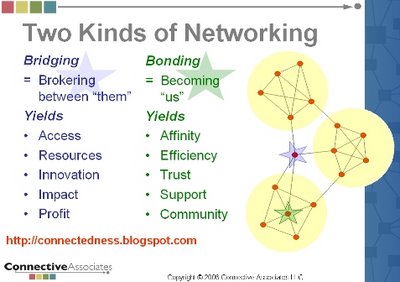
Very briefly, closure refers to the interconnectedness of one's contacts: When my contacts don't know each other, my network is "open," and when they do know each other, my network is "closed." Assuming that I am #1 (naturally), two extremes of open (left) and closed (right) are pictured below:"Open" and "closed" are pretty much the same as bridging and bonding, as I have discussed before:


For more discussion of network closure, I recommend Burt's online notes for his executive MBA course, "Strategic Leadership," specifically the chapter on Closure, which I would sum up with these two points:
  1. The peer pressure created by closed networks builds commitment and productivity
  2. The peer pressure created by closed networks reinforces groupthink and promotes mindless stereotypes
Click on the image below and you can read what Burt himself says:

This work is licensed under a Creative Commons Attribution-ShareAlike 3.0 License and is copyrighted (c) 2007 by Connective Associates LLC except where otherwise noted.

Thursday, August 07, 2008

Network Clustering: The Un-Google

Having finished our series on network centrality, we now approach its most natural complement: network clustering.

An easy way to appreciate the usefulness of network clustering is to try search engines that (unlike Google) are not centrality-driven. There are quite a few such search engines out there. They are great at providing a sense of direction within a previously unknown field --- when you're not yet sure exactly what question you're asking. In contrast, Google is better when your query is more specific, or when you just don't care about the rest of the forest, dammit, and want to find the biggest most popular tree ASAP.

Below are two examples of how non-centrality-based search engines display the WWW of "organizational network analysis". Click on either image to go to the search engine pictured.


There are dozens more search engines listed here by search engine junkie Bill Sebald.

I hope you enjoy the Un-Google world. Soon I'll say more about understanding this world with the help of network clustering.

This work is licensed under a Creative Commons Attribution-ShareAlike 3.0 License and is copyrighted (c) 2008 by Connective Associates LLC except where otherwise noted.

Wednesday, July 30, 2008

Network Centrality: Pros and Cons of Male Enhancement

Just in time for my last installment on network centrality, I have learned that Google now ranks Connectedness the #1 site on the Web for "pros and cons of male enhancement." It's tempting to take credit and say that this honor was the result of long, hard work on my part; but it was endowed upon me more by the fates of centrality than by anything I did. (Those who doubt my boast and are not afraid to look, click here: http://www.google.com/search?q=pros+and+cons+of+male+enhancement.)

Without taking anything away from the experts who have filled my blog with their thoughts on the topic, I now want to make perfectly clear my position on male enhancement: The field of collective leadership needs it bad, especially the non-profit/social-change sector.

I love working with collective leadership programs, and I am fortunate to do so regularly. The recipe for this work adapts to the participants, but it almost always involves something like the picture at right. See W.K. Kellogg Foundation's Collective Leadership Framework and the D.C. Leadership Learning Community's Nature of Collective Leadership for more.

In other sectors, collective leadership draws less with crayons and uses other more dangerous sticks. Speaking of collective leadership in the field of science, John Ziman says that each individual's contribution is "merely a tiny tentative step forward, through the jungles of ignorance." I don't think his savage choice of setting --- where only the fittest survive, thanks to teeth, claws, and other weapons --- was any accident.

My Introduction to Web Programming class has filled up again for this fall. It's my personal collective leadership learning lab. How can I equip 75 computer-illiterate college kids with the wherewithal to make their own websites (like these)? I can't. But together, they can. I facilitate my students' learning by dropping them into the Internet jungle and encouraging them to trust their own most primitive hacking instincts.

In the spirit of crayons and group hugs, my first gift to my students each term is an online discussion forum where they are encouraged to share anything relevant to the class. Speaking to a ballroom-full of faculty about his experience, Will Mundel noted first and foremost that "Thanks to the online forum we used in CS-103, students stop being individuals in a class. Rather, they are all in it together."

I am honored by Will's comment, but that's not the whole story of how my students learn to build their own websites. Underlying the experience of the class is a curriculum I have modeled on the traditional male rite of passage: (1) Throw a boy out of society into the wilderness; (2) Let him suffer and learn; and (3) Welcome the transformed man back into society. (That's my paraphrasing. Here's what the American Psychological Association says about this method of transformational learning.) If you look closely at this gallery of student projects, you'll see a quote from another student that speaks directly to her painful but ultimately victorious journey alone through the wilderness.

After subjecting my students to this webified passage of suffering, I top it off with a month-long tournament of hand-to-hand combat. Within the cage of this special-built wiki, the students compete for Google-rank supremacy. This part of the class evolved from my desire to translate the inner workings of the Google centrality algorithm into the real-life experience of the kids.

Inviting students into this kind of centrality-based competition is not easy. My first attempt provoked class revolt because students perceived the rankings as an unfair system of grading their work. (The fact that the competition had no impact on actual grades was irrelevant to this revolt.) My second attempt went smoothly: I was careful to provide a fair system for peer reviews in parallel with the same centrality-based competition. With fair peer reviews in hand, the students no longer were bothered by the arbitrariness of centrality rankings.

Last spring was my third and by far most successful use of the centrality competition. Not only was there no resentment at the arbitrariness of centrality rankings, but there was a positive embracing of the system. Students discovered how to form alliances and deliberately manipulate the Google algorithm into boosting their own rankings. A flurry of new links and surprise defections preceded the day of our awards ceremony. Three alliances shared top honors. When I refused to award a prize to one of the alliances because their team leader had skipped class that day, his teammates/co-conspirators texted him and made him show up, 20 minutes late, so that they could receive their prize: a one-half of one percent boost in final course grade.

Technical postscript: For those wondering how it's possible to share top honors in a Google centrality competition, the answer is quite technical. From this more-or-less readable description of the Google algorithm, you can discover a "damping factor" that Google does not allow users to see or edit. I provide my students with a Google centrality calculator that allows them to edit this damping factor to whatever they want. Changing the damping factor can sometimes change the winner of the rankings; I award first prize to anyone who can find a damping factor value that puts them atop the rankings. In the following network, every single node with a label can win the Google centrality contest with the right damping factor:

This work is licensed under a Creative Commons Attribution-ShareAlike 3.0 License and is copyrighted (c) 2008 by Connective Associates LLC except where otherwise noted.

Friday, July 18, 2008

Network Centrality: Making us Lazy Conformists, Says NSF

[Ed note: This is the last tangent before we really finally close the network centrality thread with a positive note, coming soon.]

The NSF reports today: "The Internet gives scientists and researchers instant access to an astonishing number of academic journals. So what is the impact of having such a wealth of information at their fingertips? The answer, according to new research released today in the journal Science, is surprising--scholars are actually citing fewer papers in their own work, and the papers they do cite tend to be more recent publications. This trend may be limiting the creation of new ideas and theories."

This is an argument for Google-induced stupidity that I can agree with (unlike last week's).

My only beef with the NSF blurb is the notion that anything "surprising" is happening here. There is plenty of evidence of our lemming-like ways in other contexts; we should expect a human tendency to dive over the cliff of the web's dark side. Here's a first-person demonstration. By doing a bit of Googling I can share the first decent link that pops up to support the claim that humans are lemmings: Conversation, Information, and Herd Behavior, in the American Economic Review, 1995. Using Google in this way, I can feel myself regressing into a rodent even now.

One of the first, most famous and shocking demonstrations of human lemmingness was devised by Solomon Asch in the 1950's. Most people after reading this story find it hard to believe that it could happen to them. I had the "good fortune" to be tricked by my college psychology professor into Asch's trap, exposing my irrational lemmingness for all my 200 classmates to see. I have no doubt that I am a weak-willed conformist.

This work is licensed under a Creative Commons Attribution-ShareAlike 3.0 License and is copyrighted (c) 2007 by Connective Associates LLC except where otherwise noted.

Monday, June 30, 2008

Network Centrality: Making Us Stupid, Says Atlantic Monthly

"Is Google Making Us Stupid?" asks Nicholas Carr on the cover of this month's Atlantic Monthly. In a nutshell, Carr laments the decline of "deep reading" and suspects that we are losing "deep thinking" as well. I would not argue the "deep reading" point, but the connection to "deep thinking" is debatable and surely this excellent rebuttal is not the last blog post that will take Carr to task.

Here I will argue Carr on a different point. About two-thirds into his essay, he says:
"Sergey Brin and Larry Page, the men who founded Google, speak frequently of their desire to turn their search engine into an artificial intelligence. 'The ultimate search engine is something as smart as people—or smarter,' Page said in a speech a few years back. 'For us, working on search is a way to work on artificial intelligence.' In a 2004 interview with Newsweek, Brin said, 'Certainly if you had all the world’s information directly attached to your brain, or an artificial brain that was smarter than your brain, you’d be better off.' ....

[Carr continues] "Such an ambition is a natural one, even an admirable one, for a pair of math whizzes with vast quantities of cash at their disposal and a small army of computer scientists in their employ.... Still, their easy assumption that we’d all 'be better off' if our brains were supplemented, or even replaced, by an artificial intelligence is unsettling. It suggests a belief that intelligence is the output of a mechanical process, a series of discrete steps that can be isolated, measured, and optimized."
Two counterarguments immediately come to mind in response to the above:
  1. For many of us, it is quite natural to believe that intelligence can be the output of a mechanical process. I suspect I am in a minority on this point, so for those who are curious to consider intelligence outside the stuff of brains, I simply recommend the book, The Mind's Eye, a collection of essays around this topic edited by Douglas Hofstadter and Daniel Dennett.
  2. In the passage above, there is a belief espoused explicitly by Brin and implicitly by Carr that is even more unsettling (at least to me) than the notion of mechanized intelligence: That we'd be "better off" if we were smarter. Read Carr's entire essay and you'll see that, just like his essay title suggests, he is very pro-smart and anti-dumb. I'll grant that with more intelligence, we have a way to boast of being "better than..."; but being "better off" is another question altogether.
In short, Carr's passion for intelligence combined with his strict accounting of its boundaries are a recipe for fundamentalism.

...

My regular readers may be wondering what happened to the "celebration of competitiveness" that I promised last time. Or maybe, what does any of this have to do with networks? Good questions. I beg your patience, dear reader-- I just could not resist this tangent, and I promise to celebrate centrality, measurement, and competitiveness soon. Meanwhile, I close with this chapter from the Tao Te Ching, which comments on the consequences of increasing intelligence:


This work is licensed under a Creative Commons Attribution-ShareAlike 3.0 License and is copyrighted (c) 2008 by Connective Associates LLC except where otherwise noted.

Monday, June 23, 2008

Network Centrality: More Current Events

Last week we kicked off our "Separation of Network Power" series in honor of the June 12 Supreme Court ruling on hearings for Guantanamo Bay detainees.

This week we'll continue the series, inspired by Congressional action of June 19 to let the White House and phone companies off the hook for warrantless tapping of domestic US communications since 2001.

Showing how far one branch of government can implicitly subjugate itself to another, Congressional Democrats claimed victory for including a special clause in the law that prohibits the White House from breaking it. In the words of the NY Times:
The most important [White House] concession that Democratic leaders claimed was an affirmation that the intelligence restrictions were the “exclusive” means for the executive branch to conduct wiretapping operations in terrorism and espionage cases. Speaker Nancy Pelosi had insisted on that element, and Democratic staff members asserted that the language would prevent Mr. Bush, or any future president, from circumventing the law. The proposal asserts “that the law is the exclusive authority and not the whim of the president of the United States,” Ms. Pelosi said.

In the wiretapping program approved by Mr. Bush after the Sept. 11 attacks, the White House asserted that the president had the constitutional authority to act outside the courts in allowing the National Security Agency to focus on the international communications of Americans with suspected ties to terrorists and that Congress had implicitly authorized that power when it voted to use military force against Al Qaeda.

Network centrality and the executive branch make for tough competitors in the struggle not only to separate but also to balance the powers of the collective. Last time I lamented the dark side of centrality and competition. Next time I'll celebrate the good side.

This work is licensed under a Creative Commons Attribution-ShareAlike 3.0 License and is copyrighted (c) 2008 by Connective Associates LLC except where otherwise noted.

Friday, June 20, 2008

Network Centrality: Size Does Matter

Today, the summer solstice, ranks with sunrises and full moons as one of the original inspirations to human time-telling and measurement. Here is a a classic New Yorker cartoon showing what that moment might have looked like.

We have come a long way since then. As recounted by author Dava Sobel, our ability to measure time with precision turned out to be the final critical breakthrough that enabled us to navigate across oceans, rather than simply drift and hope for a safe harbor to appear on the horizon. As the cartoon attests, however, we paid a high psychological price for this ticket to global connectedness. We measure time not just to travel over the horizon but also to worry about getting there soon enough.

So it is with network centrality. No matter what kind of network centrality catches your fancy, it can both empower you to navigate farther and more accurately across great "distances," and it can nag you with the question of how well you measure up.

One big difference between time and centrality is that unlike time, which rests on rhythms of nature (earth, moon, sun, cesium atoms, etc), centrality is a mathematical abstraction with a maddeningly circular non-grounding in reality. In other words, when it comes to centrality, "perception is reality." Martin Kilduff and David Krackhardt argue this much more rigorously in their Analysis of the Internal Market for Reputation in Organizations, which states: "We found that being perceived to have a prominent friend boosted reputation, but that actually having such a friend had no effect." The implications of this result for the practice of ONA consulting could not be more profound.

This work is licensed under a Creative Commons Attribution-ShareAlike 3.0 License and is copyrighted (c) 2008 by Connective Associates LLC except where otherwise noted.

Thursday, June 19, 2008

Network Centrality: All Your Links Are Belong to Us

Yesterday was a full moon. Tomorrow is the longest day of the year. What better day to celebrate the brightest metric known to network science: centrality.

Connectedness celebrates centrality by putting Google, the world's most popular centrality-based tool, to work. For any set of keywords you can imagine, Google points you to the center of that universe. Each link below does exactly that, using the highlighted text as the keywords. Results are real-time and may change after this post goes to press.
No celebration of centrality would be complete without asking, "What universe am I the center of?" For Connectedness, the answer is: sears refrigerator customer service repairman. To all my readers, let me say: Welcome to the inner sanctum.

While you're celebrating having "arrived," let me add that this weekend is the fourth birthday of Connectedness. All the more reason for jubilation.

This work is licensed under a Creative Commons Attribution-ShareAlike 3.0 License and is copyrighted (c) 2007 by Connective Associates LLC except where otherwise noted.

Monday, June 16, 2008

Holy Trinity of Network Power

Last Thursday the US Supreme Court ruled that prisoners at Guantanamo Bay have a right to hear and to challenge the reasons for their detention.

Eric M. Freedman, a habeas corpus expert at Hofstra University Law School, called the decision "a structural reaffirmation of what the rule of law means," and said it was as important a ruling on the separation of powers as the Supreme Court has ever issued, according to the NY Times.

Dating back at least to ancient Greeks, the separation of powers traditionally splits state power into three parts: executive, legislative, and judicial.

Over the next few posts, Connectedness will celebrate the separation of powers by comparing each of its three components to three notable pillars of the network perspective: centrality, clustering, and structural equivalence.

Stay tuned for something like this:

Politics

Networks

Easy-to-Remember Stereotype

Executive

Centrality

Tyrannical Dictator

Legislative

Clustering

Mob of Special Interests

Judicial

Structural Equivalence

Politically Unaccountable Intelligentsia


Hopefully by July 4th, we'll have celebrated all three.

This work is licensed under a Creative Commons Attribution-ShareAlike 3.0 License and is copyrighted (c) 2008 by Connective Associates LLC except where otherwise noted.

Friday, May 02, 2008

Claire Reinelt and Evaluation of Leadership Networks

Claire Reinelt is Director of Research and Evaluation at the Leadership Learning Community. We spent the last few months distilling our experience into a paper that we just submitted to Kelly Hannum and Bart Craig, who are guest editing a special issue of The Leadership Quarterly on Evaluation of Leadership Development. We are grateful to them for permitting us to share our manuscript.

Social Network Analysis and the Evaluation of Leadership Networks
By Bruce Hoppe and Claire Reinelt

PDF of article available here


Abstract
Leadership development practitioners have become increasingly interested in the formation of leadership networks as a way to sustain and strengthen relationships among leaders within and across organizations, communities, and systems. This paper offers a framework for conceptualizing different types of leadership networks and identifies the outcomes that are typically associated with each type of network. One of the challenges for the field of leadership development has been how to evaluate leadership networks. Social Network Analysis (SNA) is a promising evaluation approach that uses mathematics and visualization to represent the structure of relationships between people, organizations, sectors, silos, communities and other entities within a larger system. Core social network concepts are introduced and explained to illuminate the value of SNA as an evaluation and program tool.

Introduction
Leaders need effective and efficient ways to connect with one another to share information, get support, mobilize resources, learn, and align their visions in a strategic direction. Often leadership networks form (or are created) to make it easier for leaders to connect. Leadership networks form in different ways. Sometimes networks form as the result of an intentional selection process. Many leadership programs bring together diverse participants who normally would not interact: for example, professionals who work in different fields or sectors; or business and civic leaders in a community. In these programs, they have an opportunity to get to know each other, share their experiences and perspectives, and form bonds that may endure over time. While individuals who participate in programs always have the chance to keep up individually with each other, organized network activities such as listservs, retreats, and learning communities can nurture those relationships both face-to-face and online.

Other leadership networks form through a process of collective emergence (Johnson, 2001). These networks are typically more complex and capable of reaching a larger scale. They have self-organizing processes that leaders participate in out of self-interest, shared values and/or a sense of collective purpose. These leaders communicate and engage in actions that are self-directed and facilitated by ties in the network. An example of an emergent network is Amazon.com where people purchase and review books. These activities create a large amount of information that is highly valuable to someone new who is considering purchasing a book. An emergent leadership network occurs when individuals and organizations come together around a shared purpose or cause. By acting together they have a collective power that is not possible if they remain fragmented and isolated.

One of the challenges for the field of leadership development is how to evaluate leadership networks. How does one visualize, analyze, and understand the relationships among leaders? What are the boundaries of a leadership network? What are the currencies (e.g., information, resources, etc.) that flow within networks? How can a network be strengthened? Can networks be mobilized for social and systems change?

In this paper we provide a framework for understanding different types of leadership networks, and consider how social network analysis can be used as a tool for evaluating leadership networks.

We distinguish four types of leadership networks:
  • Peer leadership networks
  • Organizational leadership networks
  • Field/policy leadership networks (sometimes called “production networks”)
  • Collective leadership networks
Each of these networks can be characterized by who participates in the network, what circulates through the network (e.g., information, expertise, resources), what binds people together, and what they do for and with each other. We discuss each network type and provide examples for each. We also identify outcomes that are commonly associated with each type of network and how participants in different types of networks are using social network analysis. Interspersed throughout the paper are discussions of three methods of network assessment: connectivity, centrality and structural equivalence. We end the paper with a discussion of network visualization, the ethics of collecting and interpreting network data, and some of the most promising uses of network data for leadership development purposes.

PDF of article available here


This work is licensed under a Creative Commons Attribution-ShareAlike 3.0 License and is copyrighted (c) 2008 by Connective Associates LLC except where otherwise noted.

Friday, April 25, 2008

Knowing the path and walking the path

One of the great and tragic lessons of my life so far is that the ability to distinguish four major categories of network centrality and code them all in an Excel spreadsheet does not, in and of itself, bring me the ladies. Denial, anger, depression--somewhere amidst these precursors to acceptance comes a revelation. Perhaps network centrality will show me who is getting the ladies, so that I can learn from them, or, failing that, construct an argument demonstrating some measure by which I am superior to them.

Looking at the network of sexual relationships among Jefferson High School students (which I mentioned last time), it doesn't take a PhD to see that these kids spend plenty of time away from their spreadsheets:
No matter how liberal I am, surely my desire for public health must respond to the above network. Measures of connectivity and centrality impel me to have a talk with the "key players" of the sex network. Their reproductive health (and the health of many of their classmates) depends on it. Yes?

Actually, no. This teenage sex network does make a great emotional appeal: hire a network analyst so that you can target key players in your advocacy campaign. However, the central point made by authors of the above map, over the course of 40 pages, is exactly the opposite:

"Epidemiologists, unable to observe or measure directly the structure of sexual networks, have tended to latch onto a single idea: specifically, the idea that the number of partners matters for STD diffusion dynamics.... Our data suggest that a shift in social policy toward comprehensive STD education for all adolescents, not just those at highest risk, would be significantly more effective than current intervention models."

In other words, when it comes to teenage sex, don't waste any time targeting key players in the network. The teenage sex network, by its very nature, tends to connect in a way that makes the very notion of "key player" irrelevant. So concludes the paper "Chains of Affection" by Bearman, Moody, and Stovel.

Not all networks connect in this way. Sometimes it does pay to hire a network analyst and target key players in your advocacy campaign. Specifically, if Bob and Alice complete the partner-swap we see here (and others do likewise), then my services are definitely called for.

Kids turn out to be better than adults at avoiding these sorts of messes.


This work is licensed under a Creative Commons Attribution-ShareAlike 3.0 License and is copyrighted (c) 2007 by Connective Associates LLC except where otherwise noted.

Thursday, April 03, 2008

KM 0.0 by Dave Pollard

Recently I was invited by HP's knowledge management (KM) connector Stan Garfield to join a conference call that featured Dave Pollard. It was the first I heard the expression "KM 0.0", which was perhaps coined by Dave here. Dave describes KM 1.0 as "content and collection," and KM 0.0 as "context and connection." This not only makes for a poetic KM checklist, but it also reminds us that the better we get at KM, the more our KM draws from pre-historic roots of humanity.

My attempt in the conference call to agree with Dave did not get very far. Too many ideas in my head and not enough sense out of my mouth, I think. Nevertheless, those who want to support Dave's "KM 0.0" notion will do well to notice how 1920's anthropological study of archaic societies anticipates this 2006 MIT Sloan Management Review cover on "Enterprise 2.0."

Dave's poem also deserves more consideration:

Content, collection;
Context, connection.

I interpret this poem as a tribute to Amazon.com and other exemplars of the Long Tail phenomenon--digital hosts who provide not only content but also ways for users to interact through their experience of that content. It's an amazingly successful network recipe cooked with equal measures of centrality, clustering, and structural equivalence.

Too many ideas in my head now, so I must sign off.

This work is licensed under a Creative Commons Attribution-ShareAlike 3.0 License and is copyrighted (c) 2007 by Connective Associates LLC except where otherwise noted.