Thursday, June 30, 2005
Social Networks and the Hype Curve
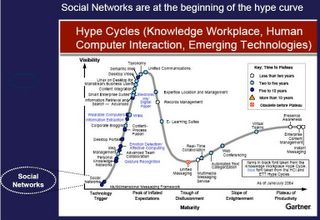
Thanks to Lynda Moulton of Boston's KM Forum for posting the slides to Kate Ehrlich's recent talk on social network analysis. One of my favorite visuals from Kate's talk was a "Hype Curve" from the Gartner Group, which shows how new technologies initially grow too fast for their own good, crashing from a "Peak of Inflated Expectations" into a "Trough of Disillusionment" before stabilizing on a "Plateau of Productivity." Below you can see Gartner's 2004 estimation that SNA is only at the beginning of a wild ride:
This view of SNA coincides with the guarded optimism I've reported from scholars like Steve Borgatti. (And see here for recent comments on this topic.) One of my more ambitious goals in writing this blog is to help temper the initial burst of irrational SNA exuberance and help raise the ultimate plateau of SNA productivity. I'd say Kate's research is also in line with that measured approach, and I recommend her paper in progress (co-authored with Inga Carboni), "Inside Social Network Analysis," as a nice introduction.


Tuesday, June 28, 2005
Summer Social Network Camp
After far too long without a vacation, I splurged last week on one of my mini-fantasies: an all-inclusive Caribbean beach extravaganza. I spent seven days and six nights at Club Med, Turks & Caicos, where every leisure activity was at my disposal. I could grab a catamaran literally ten steps outside my room and ride the trade winds over a gloriously luminous ocean. Or I could lounge poolside and admire the savage tans of my vacationing cohorts while sipping unlimited drinks of every variety. Along the way I learned snorkeling, scuba diving, and trapeze flying (!), and I enjoyed such delicacies as stuffed quail and frogs legs, not to mention the subtle sweetness of fresh goat milk on my breakfast cereal.
Very nice, you may say, but doesn't Connectedness stick to business? What does my fantasy week have to do with social network analysis, organizational development, or community building?
Good question. And perhaps the answer is nothing. But as I was enjoying the last few sweets of my final dinner Monday, I couldn't help anticipating my imminent return to work by doing a workflow analysis of Club Med, Turks & Caicos. My analysis was inspired by the club's amazing staff of "Gentils Organiseurs" (G.O's)---beautiful young people who live rather like guests except that instead of relaxing they are always putting on daily activities, lessons, expeditions, and nightly shows for the benefit of the rest of us. It stuck me that in their diligent efforts to provide us with unending options of entertainment, the G.O's were also keeping us from the fun of entertaining ourselves. Personally, I would have loved a chance to organize some activity for the benefit of my fellow guests. With a little bit of network perspective, Club Med could help me have even more fun, and take a bit of grunt work off the shoulders of the G.O's. Does anyone know of adult camp/ resorts that already employ this philosophy? I'd love to hear.
Very nice, you may say, but doesn't Connectedness stick to business? What does my fantasy week have to do with social network analysis, organizational development, or community building?
Good question. And perhaps the answer is nothing. But as I was enjoying the last few sweets of my final dinner Monday, I couldn't help anticipating my imminent return to work by doing a workflow analysis of Club Med, Turks & Caicos. My analysis was inspired by the club's amazing staff of "Gentils Organiseurs" (G.O's)---beautiful young people who live rather like guests except that instead of relaxing they are always putting on daily activities, lessons, expeditions, and nightly shows for the benefit of the rest of us. It stuck me that in their diligent efforts to provide us with unending options of entertainment, the G.O's were also keeping us from the fun of entertaining ourselves. Personally, I would have loved a chance to organize some activity for the benefit of my fellow guests. With a little bit of network perspective, Club Med could help me have even more fun, and take a bit of grunt work off the shoulders of the G.O's. Does anyone know of adult camp/ resorts that already employ this philosophy? I'd love to hear.
Sunday, June 19, 2005
Happy Birthday Connectedness!
One year ago Bill Ives told me I should try blogging. Thanks, Bill!

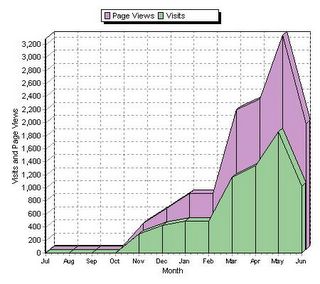
I've had a lot of fun writing since then. Just as Bill explained to me, this blog has been a wonderful personal filing cabinet, of great use to me even if nobody else reads it. But it does get more exciting when people do read it, which has been happening increasingly often of late. Below is the year in visits and page views. June is on pace to be our biggest month yet--if y'all can keep stopping by even while I'm off the Internet for the next week. Thanks for reading, everybody!
I've had a lot of fun writing since then. Just as Bill explained to me, this blog has been a wonderful personal filing cabinet, of great use to me even if nobody else reads it. But it does get more exciting when people do read it, which has been happening increasingly often of late. Below is the year in visits and page views. June is on pace to be our biggest month yet--if y'all can keep stopping by even while I'm off the Internet for the next week. Thanks for reading, everybody!
Thursday, June 16, 2005
"Organizational X-Ray"--an SNA metaphor that is all too apt?
Last week I visited the MIT office of David Hartzband, where we had a fascinating conversation around all sort of topics related to technology and organizations. Along the way David introduced me to CP Snow's "The Two Cultures" and the super pre-categorizing Internet search tool Clusty (not as visually slick as Grokker but more powerful). David has been CTO of several major technology firms and I found his awareness of the technical landscape really breathtaking.
At the end of our meeting, David challenged me with his impression that he sees SNA as a fascinating tool without clear business value. Moreover, amongst David's wide circle of contacts, SNA has polarized the ranks. Half of them love SNA and the other half are bitter about money wasted on opportunistic SNA consultants.
I told David how his perspective reminds me of Steve Borgatti, who months ago explained to me his concern that SNA will get burned by excessive buzz, as legions of inexpert entrepreneurs grab some quick SNA cash and leave the marketplace forever resentful that they ever heard of social networks.
We often use the "organizational x-ray" metaphor in this business, and I think now is a good time to remind ourselves that it took us decades to figure out what x-rays are good for, and not good for. Did anyone out there ever have their shoe size measured by a department store x-ray machine? These were common in the 40s and 50s before their hazards were well understood and they were outlawed. Word didn't get everywhere, however, and the last operational shoe-size x-ray wasn't mothballed until 1981.
Of course, the flip side of this is where would modern medicine be without x-rays? Many of us owe our lives (or limbs or teeth) to timely insights provided by responsible use of this remarkable technology.
So be wary of whiz-bang SNA shoe-size machines and let's focus on connecting this technology to places where it really helps.
At the end of our meeting, David challenged me with his impression that he sees SNA as a fascinating tool without clear business value. Moreover, amongst David's wide circle of contacts, SNA has polarized the ranks. Half of them love SNA and the other half are bitter about money wasted on opportunistic SNA consultants.
I told David how his perspective reminds me of Steve Borgatti, who months ago explained to me his concern that SNA will get burned by excessive buzz, as legions of inexpert entrepreneurs grab some quick SNA cash and leave the marketplace forever resentful that they ever heard of social networks.
We often use the "organizational x-ray" metaphor in this business, and I think now is a good time to remind ourselves that it took us decades to figure out what x-rays are good for, and not good for. Did anyone out there ever have their shoe size measured by a department store x-ray machine? These were common in the 40s and 50s before their hazards were well understood and they were outlawed. Word didn't get everywhere, however, and the last operational shoe-size x-ray wasn't mothballed until 1981.
Of course, the flip side of this is where would modern medicine be without x-rays? Many of us owe our lives (or limbs or teeth) to timely insights provided by responsible use of this remarkable technology.
So be wary of whiz-bang SNA shoe-size machines and let's focus on connecting this technology to places where it really helps.
Tuesday, June 14, 2005
Let's raise a flag to community building
Happy Flag Day everybody!
Yesterday I presented "Social Network Analysis: A Tool for Community Development" at the Center for Youth and Communities, which is part of the Heller School at Brandeis University. Thanks to Ginger Fitzhugh (whom I met at the Mass Bay OD Learning Group) for inviting me to speak in front of such an interested and interesting audience.
In my presentation I referred to a few key resources that I recommend to anyone interested in social networks and community development:
Start with the Barr Foundation's page of resources, which includes "Network Power for Philanthropy and Nonprofits," a high-level primer, along with two great case studies about Lawrence Community Works and The Appalachian Center for Economic Networks.
When you're ready to delve deeper, read "NGO Networks: Building Capacity in a Changing World," a truly brilliant study commissioned by USAID's Office of Private Voluntary Cooperation, which is stored in their extensive public database.
There are also some very practical materials relevant to inter-organizational collaboration published freely by NY Academy of Medicine's Center for the Advancement of Collaborative Strategies in Health.
If you'd like a copy of my presentation, just e-mail me and I'll send it to you.
[Ed: See also this closely related and more recent Living Bibliography for Leadership Network Development.]
Yesterday I presented "Social Network Analysis: A Tool for Community Development" at the Center for Youth and Communities, which is part of the Heller School at Brandeis University. Thanks to Ginger Fitzhugh (whom I met at the Mass Bay OD Learning Group) for inviting me to speak in front of such an interested and interesting audience.
In my presentation I referred to a few key resources that I recommend to anyone interested in social networks and community development:
Start with the Barr Foundation's page of resources, which includes "Network Power for Philanthropy and Nonprofits," a high-level primer, along with two great case studies about Lawrence Community Works and The Appalachian Center for Economic Networks.
When you're ready to delve deeper, read "NGO Networks: Building Capacity in a Changing World," a truly brilliant study commissioned by USAID's Office of Private Voluntary Cooperation, which is stored in their extensive public database.
There are also some very practical materials relevant to inter-organizational collaboration published freely by NY Academy of Medicine's Center for the Advancement of Collaborative Strategies in Health.
If you'd like a copy of my presentation, just e-mail me and I'll send it to you.
[Ed: See also this closely related and more recent Living Bibliography for Leadership Network Development.]
Monday, June 13, 2005
Enronic: a new email-based network visualization tool
Those of you who took my advice two weeks ago and are trying to load two years of Enron's email into TeCFlow may also want to take a look at Enronic, specially created for that very purpose by Jeffrey Heer, a CS PhD student at UC Berkley. Enronic was recently featured on boingboing. For additional background reading you can also see the recent proceedings of last week's Email archive visualization workshop at the University of Maryland.
I haven't put the pieces of Enronic together myself yet but the publicity looks pretty hot.
I haven't put the pieces of Enronic together myself yet but the publicity looks pretty hot.
Thursday, June 09, 2005
Dan Brass on social networks' impact on HR
Thanks to Kate Ehrlich for introducing me to the research of Dan Brass, J. Hennings Hilliard Chair in Innovation Management at the University of Kentucky. Dan has done impressive work studying how social networks affect human resource management. I corresponded briefly with Dan and he graciously allowed me to share this article of his: "A Social Network Perspective on Human Resource Management," from Research in Personnel and Human Resources Management, 1995, vol. 13, pp. 39-79.
Reading the first couple pages of this article is rather like opening a time capsule. The social network perspective had not made it very far out of academia in 1995. You can imagine Dan's audience talking on huge clunky cell phones and wondering what all the fuss is about grunge rock, at the same time Dan is explaining how social networks bring measurement of relationships into a field (HR) focused on competencies of individuals. Thanks to the vision and work of Dan and others, we have come a long way since then.
Dan nicely categorizes the impact of social networks on HR. Starting with most basic fundamentals and proceeding to more complex effects, he orders them
For more on HR and SNA, see this previous post.
Reading the first couple pages of this article is rather like opening a time capsule. The social network perspective had not made it very far out of academia in 1995. You can imagine Dan's audience talking on huge clunky cell phones and wondering what all the fuss is about grunge rock, at the same time Dan is explaining how social networks bring measurement of relationships into a field (HR) focused on competencies of individuals. Thanks to the vision and work of Dan and others, we have come a long way since then.
Dan nicely categorizes the impact of social networks on HR. Starting with most basic fundamentals and proceeding to more complex effects, he orders them
- Attitude similarity
- Job satisfaction
- Power and politics
- Recruitment
- Selection
- Socialization
- Training
- Performance
- Career development
- Turnover
- Conflict
For more on HR and SNA, see this previous post.
Subscribe to:
Posts (Atom)

