Thanks to those of you who post comments on Connectedness. It's nice to hear from you all. Yesterday Tiffster posted a thoughtful rebuttal to my post, warning of card-collectors and other dubious contacts, seconded by Valdis.
I emphatically agree with tiffster's comments, btw.
But it seems that the real point of my orginal post didn't make it across. Here's another way I can say it: Have you ever looked at a screenful of 2nd and 3rd degree contacts on LinkedIn and wondered, which of my personal friends connects me to each of these targets? Just as tiffster says, not all introductions are equal. And for that very reason, I find it annoying that LinkedIn won't reveal the introducer's identity (who is one of my personal friends, after all) until I delve specifically into one target's profile.
From that scenario it is one more step to contemplate aggregated reports, which is what I suggested yesterday.
Tuesday, July 26, 2005


Monday, July 25, 2005
Fishing with a net, works (AKA my new favorite use of LinkedIn)
[Hey you guys at LinkedIn, Visible Path, et al. If you haven't thought of the following idea already, please send royalty checks to http://link-to-results.com. Thanks! -Ed.]
Though I am on record as a social software skeptic, I am also both (1) a fan of SNA, and (2) stubborn and methodical as hell. So here's what I discovered today. I had just finished assembling a long list of target firms--80 corporations I would love to be introduced to. What to do next? Believe it or not, I spent two whole days concocting strategies to turn this list into real live contacts before it occured to me, "What the hell, why don't I try LinkedIn."
So I went and typed each of my 80 target companies into LinkedIn, one by one. Only twice did I find a useful introduction; far more often I was three degrees or more from my goal--not so useful. Rats!
As I trudged through this rather tedious business, one truly interesting thing emerged. I kept seeing the same couple contacts again and again. I had discovered the "boundary spanners" who connect my world to the universe of my 80 target companies. Suddenly I knew that instead of focusing on getting introduced to each of my 80 target companies, I should go learn from these boundary spanners and open my horizons to opportunties I couldn't even begin to list.
Well, that's classic networking; but I had never thought of using LinkedIn quite like that until I just stumbled into it. And once I did stumble into it, LinkedIn helped me identify a few boundary spanners that I probably would not have guessed by myself.
Now can you guys (you know who you are) please go and automate this process? Here's what you need to do: Give me an option so when I say "Link me to industry sector X" I can see either (1) individual introductions to sector X, listed in order of degrees removed, or (2) a list of all my contacts, showing the relative frequency with which each of them connects me to the universe of sector X accounts on LinkedIn. If I am connected to someone linked to ten different people in sector X, I want to know! This is the stuff from which partnerships are born.
As they say, "Give a man a fish and he eats for a day; but teach a man to fish and he eats for a lifetime." To that I add, "Introduce a man to a fisherman and he can eat for a lifetime without ever having to catch a fish." Yum!
Though I am on record as a social software skeptic, I am also both (1) a fan of SNA, and (2) stubborn and methodical as hell. So here's what I discovered today. I had just finished assembling a long list of target firms--80 corporations I would love to be introduced to. What to do next? Believe it or not, I spent two whole days concocting strategies to turn this list into real live contacts before it occured to me, "What the hell, why don't I try LinkedIn."
So I went and typed each of my 80 target companies into LinkedIn, one by one. Only twice did I find a useful introduction; far more often I was three degrees or more from my goal--not so useful. Rats!
As I trudged through this rather tedious business, one truly interesting thing emerged. I kept seeing the same couple contacts again and again. I had discovered the "boundary spanners" who connect my world to the universe of my 80 target companies. Suddenly I knew that instead of focusing on getting introduced to each of my 80 target companies, I should go learn from these boundary spanners and open my horizons to opportunties I couldn't even begin to list.
Well, that's classic networking; but I had never thought of using LinkedIn quite like that until I just stumbled into it. And once I did stumble into it, LinkedIn helped me identify a few boundary spanners that I probably would not have guessed by myself.
Now can you guys (you know who you are) please go and automate this process? Here's what you need to do: Give me an option so when I say "Link me to industry sector X" I can see either (1) individual introductions to sector X, listed in order of degrees removed, or (2) a list of all my contacts, showing the relative frequency with which each of them connects me to the universe of sector X accounts on LinkedIn. If I am connected to someone linked to ten different people in sector X, I want to know! This is the stuff from which partnerships are born.
As they say, "Give a man a fish and he eats for a day; but teach a man to fish and he eats for a lifetime." To that I add, "Introduce a man to a fisherman and he can eat for a lifetime without ever having to catch a fish." Yum!
Tuesday, July 19, 2005
Addictive network game
For those of you hesitant to try crack or crystal meth, I just discovered an equally addictive pastime you might consider. The "Planarity Flash Game" presents a network on-screen and invites you to reposition the nodes so that there are no crossing edges. For example, can you see how to uncross the edges in the following network?
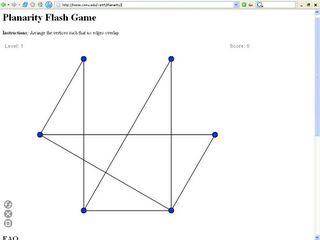
In fact, you can uncross all the edges in the above network just by moving the "9-oclock" node up and to the right.
After you uncross all the edges in one network, the game presents you another, more difficult network. If you like networks, it's hard to stop!
Thanks to Eszter on SOCNET for sharing this.
BTW, playing this game will give you a lot more appreciation for the complexities of network visualization.
After you uncross all the edges in one network, the game presents you another, more difficult network. If you like networks, it's hard to stop!
Thanks to Eszter on SOCNET for sharing this.
BTW, playing this game will give you a lot more appreciation for the complexities of network visualization.
Thursday, July 14, 2005
Battle of the Network Blogs
I learned a few lessons in blogging the other day, while comparing notes with Mal Watlington. Mal and I are co-presenting a "Battle of the Blogs" next week at the Mass Bay Organizational Development Learning Group (ODLG).
I'm looking forward to our presentation. Blogs are one of those things that seem more high tech than they really are, especially to a decidedly tech-averse group like ODLG. Mal and I hope to demystify blogs while sharing our experience of how they are useful to professionals in general and OD consultants in particular.
Talking with Mal, I discovered that I am a fairly low-tech blogger. I go about my day, and much of what I share in Connectedness I learn about in old-fashioned ways like talking with people and reading articles. In a typical day I do not read a single blog, although I do rely on the Internet heavily and consider myself a brown-belt Googlemeister. Meanwhile, uber-bloggers like Robert Scoble manage to "read" 1,000 blogs a day, thanks largely to ever more sophisticated aggregator technology.
Moreso than aggregators, I'd list search engines and social bookmarks as the top gee-whiz assistants to my personal information gathering. Recently I commented on OutFoxed as a nice tool that integrates both searching and social bookmarking, by re-ordering my google results according to feedback from my network of trusted informers. Just yesterday this network-assisted search unexpectedly turned up a living overview of social bookmarks maintained on the community blog ConsultantCommons. Then I looked at myself with an ironic smirk: Funny how we so easily get caught up in feeding technology upon itself.
I'm looking forward to our presentation. Blogs are one of those things that seem more high tech than they really are, especially to a decidedly tech-averse group like ODLG. Mal and I hope to demystify blogs while sharing our experience of how they are useful to professionals in general and OD consultants in particular.
Talking with Mal, I discovered that I am a fairly low-tech blogger. I go about my day, and much of what I share in Connectedness I learn about in old-fashioned ways like talking with people and reading articles. In a typical day I do not read a single blog, although I do rely on the Internet heavily and consider myself a brown-belt Googlemeister. Meanwhile, uber-bloggers like Robert Scoble manage to "read" 1,000 blogs a day, thanks largely to ever more sophisticated aggregator technology.
Moreso than aggregators, I'd list search engines and social bookmarks as the top gee-whiz assistants to my personal information gathering. Recently I commented on OutFoxed as a nice tool that integrates both searching and social bookmarking, by re-ordering my google results according to feedback from my network of trusted informers. Just yesterday this network-assisted search unexpectedly turned up a living overview of social bookmarks maintained on the community blog ConsultantCommons. Then I looked at myself with an ironic smirk: Funny how we so easily get caught up in feeding technology upon itself.
Tuesday, July 12, 2005
Personal Social Network Action Plan
Thanks to Peter Gloor for pointing me a while ago to "Who Knows Whom, and Who Knows What," an article about business to business SNA in June's CIO Magazine.
Patti Anklam wrote a nice follow-up to this article, saying,
So far I haven't seen anyone else mention my most favorite part of the article, which is a link to Rob Cross's Personal Social Network Action Plan. It puts SNA data in the context of what one individual can do to be more effective in her work, and it reads like a thoughtful reply to Patti's comment, quoted above.
Patti Anklam wrote a nice follow-up to this article, saying,
"It's not 'doing SNA' to a group of people, it's developing work habits that embrace creating and sustaining networks of relationships and managing them responsibly; SNA is just a diagnostic that often helps stimulate the thinking around the change. But the real changes are in work habits and work practices, in understanding how people accomplish their work, the roles of other people in that accomplishment, and moving that work to a higher level."Many others have also commented on this article in the weeks since its publication, including Visible Path and MeshForum.
So far I haven't seen anyone else mention my most favorite part of the article, which is a link to Rob Cross's Personal Social Network Action Plan. It puts SNA data in the context of what one individual can do to be more effective in her work, and it reads like a thoughtful reply to Patti's comment, quoted above.
Thursday, July 07, 2005
The Economist on jerks, fools, and SNA
The Economist also noted the competent jerks and lovable fools I mentioned in my last post. In the same article they include a great quote on the SNA craze, "re-evaluating jolly types who spend long hours hanging around water coolers is currently fashionable," before segueing neatly to Ron Burt. See "The Jerk at Work: Wise Enough to Play the Fool?"
Social networks of jerks and fools
Suppose you need help completing a project at work. You can ask Alice, who is professionally expert but personally prickly; or you can ask Brenda, who is very likable but doesn't know much that can help you. When faced with that hypothetical question, most people choose the competence of Alice over the likability of Brenda. Did you choose similarly?
Researchers have found that the real story is more complicated. When faced with a real-life choice, most people ignore their stated preference for competence and actually choose likability first.
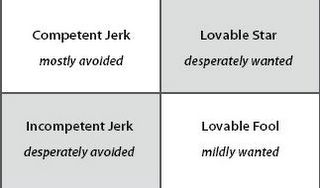
Ideally, of course, we wouldn't have to choose between competence and likability. We'd work exclusively with people who are both. These are the "lovable stars"---highly sought after folks in short supply. Once the "lovable stars" are all taken, we must then choose between the "competent jerks" and the "lovable fools." Or when desperation strikes and all we need is another warm body, it may be time to recruit from the pool of "incompetent jerks."
For more on this phenomenon and how it relates to professional social networks, see June 2005's Harvard Business Review, which includes the article "Competent Jerks, Lovable Fools, and the Creation of Social Networks," by Tiziana Casciaro and Miguel Sousa Lobo. (The artcle PDF is also available for free here.)
The authors describe a three-pronged approach to managing the tradeoffs of competent jerks and lovable fools: (1) manufacture liking, (2) leverage the likable, and (3) reform the jerks.
Under leveraging the likable, the authors describe how lovable fools can help organizations in the role of "affective hub." Joe Labianca (Professor of Organization & Management at Emory University) once told me a perfect story of an affective hub. A client of his was about to fire someone who was seemingly incompetent and/or lazy, until Joe's social network analysis revealed that this person was very much liked by and connected to every corner of the organization. So instead of firing him, the managers recognized this lovable fool as a key resource in winning widespread support for their new initiatives. Their ability to promote sustainable change improved dramatically as a result. Wow!
Thanks to my friend Todd Harris for the tip on this, and I also recommend you see Patti Anklam's post on this same article, as well as this nice review by Four Groups.
***
Taking a step back from this article, I'd say one thing that makes it so catchy is its use of "jerks" and "fools." The authors deliberately contradict the SNA tradition of focusing just on positive relationships, with dramatic effect.
Once again, this reminds me of Joe Labianca. He has been doing groundbreaking research in balancing the social network ledger by including negative relationships as much as positive relationships. As he explains in this thoughtful paper, negative relationships have received far too little attention. In fact, Joe suggests that negative relationships are more critical than positive ones in affecting key organizational attributes like performance.
Joe is certainly not the only one uncovering the dynamics of positive and negative social networks. Rob Cross and others have been doing related work on energy in organizations. But this post is too long already, so I'm going to save that discussion for later.
Researchers have found that the real story is more complicated. When faced with a real-life choice, most people ignore their stated preference for competence and actually choose likability first.
Ideally, of course, we wouldn't have to choose between competence and likability. We'd work exclusively with people who are both. These are the "lovable stars"---highly sought after folks in short supply. Once the "lovable stars" are all taken, we must then choose between the "competent jerks" and the "lovable fools." Or when desperation strikes and all we need is another warm body, it may be time to recruit from the pool of "incompetent jerks."
For more on this phenomenon and how it relates to professional social networks, see June 2005's Harvard Business Review, which includes the article "Competent Jerks, Lovable Fools, and the Creation of Social Networks," by Tiziana Casciaro and Miguel Sousa Lobo. (The artcle PDF is also available for free here.)
The authors describe a three-pronged approach to managing the tradeoffs of competent jerks and lovable fools: (1) manufacture liking, (2) leverage the likable, and (3) reform the jerks.
Under leveraging the likable, the authors describe how lovable fools can help organizations in the role of "affective hub." Joe Labianca (Professor of Organization & Management at Emory University) once told me a perfect story of an affective hub. A client of his was about to fire someone who was seemingly incompetent and/or lazy, until Joe's social network analysis revealed that this person was very much liked by and connected to every corner of the organization. So instead of firing him, the managers recognized this lovable fool as a key resource in winning widespread support for their new initiatives. Their ability to promote sustainable change improved dramatically as a result. Wow!
Thanks to my friend Todd Harris for the tip on this, and I also recommend you see Patti Anklam's post on this same article, as well as this nice review by Four Groups.
***
Taking a step back from this article, I'd say one thing that makes it so catchy is its use of "jerks" and "fools." The authors deliberately contradict the SNA tradition of focusing just on positive relationships, with dramatic effect.
Once again, this reminds me of Joe Labianca. He has been doing groundbreaking research in balancing the social network ledger by including negative relationships as much as positive relationships. As he explains in this thoughtful paper, negative relationships have received far too little attention. In fact, Joe suggests that negative relationships are more critical than positive ones in affecting key organizational attributes like performance.
Joe is certainly not the only one uncovering the dynamics of positive and negative social networks. Rob Cross and others have been doing related work on energy in organizations. But this post is too long already, so I'm going to save that discussion for later.
Subscribe to:
Posts (Atom)


