Tuesday, August 29, 2006

The Community of Practice heard round the world

The Connectedness staff is back at the blog after a wonderful summer vacation. While resting at the Omega Institute, I got a hoot reading Gordon Wood's pithy history, The American Revolution. I have been addicted to founding-father bios for a few years now. Reading this high-level overview of the period gave me new clarity on the hook of my addiction: The American Revolution is arguably the greatest organizational development case study of all time. This realization put a bit of a damper on the idea that I was actually vacationing, but I enjoyed the epiphany nonetheless.

There are parts of Wood's historical analysis that seem aimed more at our current administration than its forebears. Writing after the U.S. invasion of Afghanistan but before Iraq, Wood says:
British disadvantages [in 1775] were immense and perhaps overwhelming.... A well-trained army might have been able to to conquer the American forces, but... America itself was unconquerable. The great breadth of territory and the wild nature of the terrain made conventional maneuverings and operations difficult and cumbersome. The fragmented and local character of authority in America inhibited decisive action by the British. There was no nerve center anywhere whose capture would destroy the rebellion. The British generals came to see that engaging Washington's army in battle ought to be their main objective; but, said the British commander in chief, they did not know how to do it, "as the enemy moves with so much more celerity than we possibly can."
For more on how Washington's tactics of 1776 are being used today by Hezbollah, Al Quaeda, and other social action groups, see "Networks, Netwars, and the Fight for the Future," which was originally recommended to me by Kate Ehrlich. When you read this paper, savor the irony of its opening line:
Netwar is an emerging mode of conflict in which the protagonists use network forms of organization, doctrine, strategy, and technology.... The practice of netwar is well ahead of theory, as both civil and uncivil society actors are increasingly engaging in this new way of fighting.
This work is licensed under a Creative Commons Attribution-ShareAlike 2.5 License and is copyrighted (c) 2006 by Connective Associates except where otherwise noted.

Friday, August 04, 2006

Online identity verification and two-sided networks

Yesterday's Wall Street Journal had this on the top of its front page: "Building Trust Into Web Identities." When we interact online, it's increasingly important to know who is on the other side of the screen. There are many services emerging that provide various forms of ID verification, which are covered nicely in the article. The article goes just deep enough to give a quick nod to the forward-looking Higgins Project, which is being led by Parity Communications (mentioned here yesterday) with support from IBM and Novell.

It's important to note that ID-verification services are fighting to attract two completely different sets of users. They must enlist websites to license their technology and they must enlist users to register for IDs. Both sides are absolutely essential to any successful ID-verification service.

Several days ago I lunched with Marshall Van Alstyne as he explained this pervasive two-sided business phenomenon, which is old as the hills but only recently something specifically named and studied by economists. Marshall and his colleagues call it a "two-sided network." Stay tuned for a lot more popular business press on this topic in the near future. Meanwhile, you can see Geoffrey Parker's home page for his paper "Two-Sided Network Effects," co-authored with Marshall.

This work is licensed under a Creative Commons Attribution-ShareAlike 2.5 License and is copyrighted (c) 2006 by Connective Associates except where otherwise noted.

Thursday, August 03, 2006

Visualizing organizational change

Social network analysis is often discussed as a way to see "how an organization really works." Less often do people acknowledge that "how an organization is changing" is often even more important than "how it is working." SNA researchers are hard at work developing ways of measuring change (typically under the name of "longitudinal studies"). Unfortunately, in a field that already suffers from interesting but hard-to-use technology, longitudinal methods of SNA are even more difficult to grasp and apply than their static snapshot counterparts (by a wide margin).

All that makes it even more impressive that the Accenture Institute for High Performance Business, led by Bob Thomas, has produced a relatively accessible dramatization of how real-time dynamic SNA can be a powerful business tool in the not-too-distant future.

I had the privilege of creating this seven-minute Flash video for Bob, in collaboration with Sarah Maloney of Accenture, Paul Trevithick and Mary Ruddy of Parity Communications and Barry O'Brien of North Shore Communications. You can see our handiwork here.
This work is licensed under a Creative Commons Attribution-ShareAlike 2.5 License and is copyrighted (c) 2006 by Connective Associates except where otherwise noted.

Monday, July 24, 2006

Networks of negative relationships

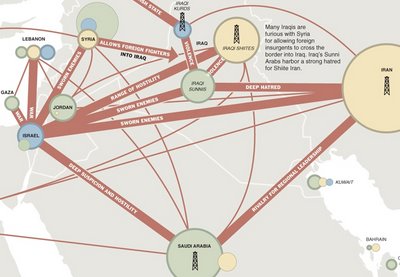
Social networks bring to mind collaboration for many of us; however, the word "network" is equally appropriate to describe interconnected negative relationships. Yesterday's NY Times featured an amazing picture of the Middle East where the links run the gamut from "rivals" to "deep hatred" to "sworn enemies" to "war":
As I mentioned in a post on jerks and fools at the office, negative relationships often influence the big picture more than their positive counterparts, and the study of negative-valued social networks is still underappreciated. Professor Joe Labianca is one of the researchers working hardest at "balancing the ledger" to understand social networks that include negative as well as positive relationships.

Asking someone to name his sworn enemies amongst his co-workers might be impractical. But in "no holds barred" arenas (love, war, etc.) mapping negative relationships is sometimes feasible and almost always more revealing than mapping positive relationships. Just take a look at these network maps of political scandal previously published by the NY Times to see how lame positive-valued network maps can be in comparison to the Middle East map of hatred, above.

This work is licensed under a Creative Commons Attribution-ShareAlike 2.5 License and is copyrighted (c) 2006 by Connective Associates except where otherwise noted.
Thursday, July 20, 2006

Floyd Landis is God

Today American Floyd Landis gave the world one of the greatest individual cycling performances of all time. [Update: perhaps the most infamous ride of all time. Sigh.]

Landis, among the initial favorites to win the Tour de France, seemingly fell from contention yesterday when he "bonked" and lost over ten minutes to his rivals. But today Landis more than rebounded. Singlehandedly, he rode away from everyone and took back all that time (all but 31 seconds). With one time trial stage remaining, Landis must now be considered the Tour de France favorite once again.

Such over-the-top displays of individual athleticism are rare in the Tour de France, where winners typically succeed only thanks to behind-the-scenes sacrifice by their teammates. During last year's Tour de France, I said of cycling that "few Americans appreciate the team dynamics and strategy that are the heart of what road racing is about." It's a sport sophisticated enough to inspire 21st century innovations in the mathematics of game theory.

Nothing was remotely subtle, sophisticated, or behind-the-scenes about Landis's strategy today.

BTW, did I mention that Landis has a degenerative hip disorder and is due for joint replacement as soon as the Tour is over? (Reported last week by NY Times Magazine.)

Go Floyd!

[Update 2: Can anyone confirm the rumor that Blogger.com is going to start testing "Blog of the Day" winners for unnaturally high levels of caffeine?]

This work is licensed under a Creative Commons Attribution-ShareAlike 2.5 License and is copyrighted (c) 2006 by Connective Associates except where otherwise noted.

Wednesday, July 12, 2006

Are you networked for successful innovation?

MIT Sloan Management Review recently published "Are you networked for successful innovation?" by Professor Polly Rizova of Boston University.

Based on in-depth study of six projects in the R&D lab of a Fortune 500 corporation, Rizova summarizes four key factors behind successful innovation:
  1. Strong corporate support
  2. Open communication without formal reporting
  3. A "technical star" who is central in the technical-advice network
  4. A “managerial star” who is central in the organizational-advice network
Interestingly, Rizova also looked at information-sharing networks and friendship networks, and found these much less relevant than the factors listed above.

Rizova acknowledges that these four factors alone are not enough--they must reinforce each other in order to work. She goes on to discuss the complementary values of the technical-advice and organizational-advice networks, and how people's actual roles in these networks can help inform their explictly prescribed roles in the organization.

This article is a must-read for leaders of R&D units.

It's also a great SNA case study for those wondering exactly which social networks are relevant to their organizational goals. This is one of the hottest questions going in the ONA community of practice (which spawned from the SNA Jump Start conference). For a good follow-up case study, see also David Krackhardt's HBR classic about technical-advice and trust networks.

Thanks to Francesca Grippa for alerting me to this article.

This work is licensed under a Creative Commons Attribution-ShareAlike 2.5 License and is copyrighted (c) 2006 by Connective Associates except where otherwise noted.

Monday, July 10, 2006

Network healing and adaptability

Yesterday the Italians won the World Cup, but the bigger story is the exuberant return of German patriotism.

I am not old enough to remember the Third Reich or the rise of the Iron Curtain, but I was just graduating from college when the Berlin wall came down. What a happy day that was. Today seems like an even happier day for the Germans -- while the rest of us get to be happy for them. Congratulations!

Germany's recovery comes well-timed to keep my spirits up when a community dear to my heart has just taken a bit of a beating.

Several years ago, after a long period of searching and reflection, I joined a Unitarian Universalist church. My growth from cross-armed skeptic to active community member is one of the great healing gifts of my life, a gift I received thanks to three people in particular -- Thomas Mikelson, Chris Bell, and Rita Butterfield.

In the past month, I have bid farewell to all three of these champion network weavers. Thomas retired in June after 17 years of leading our church. That same weekend, our congregation ordained Chris -- one of our long-time members, and a recent divinity school graduate. Now Chris is taking his immense talents and his wife Rita to Santa Rosa, CA, where he will lead his own church. Yesterday I saw Chris and Rita for the last time.

Farewell, Thomas, Chris and Rita! We will not be the same without you.

This work is licensed under a Creative Commons Attribution-ShareAlike 2.5 License and is copyrighted (c) 2006 by Connective Associates except where otherwise noted.