Monday, March 23, 2009

SNA and Leadership Networks

Claire Reinelt and I are pleased to share our paper, "Social Network Analysis and the Evaluation of Leadership Networks, " which is due for publication in a special issue of Leadership Quarterly (Elsevier) on the topic of evaluating leadership. Look for it on news stands in early 2010.

Social Network Analysis and the Evaluation of Leadership Networks (PDF)
Bruce Hoppe, PhD
Connective Associates LLC
Claire Reinelt, PhD
Leadership Learning Community
Abstract
Leadership development practitioners have become increasingly interested in networks as a way to strengthen relationships among leaders in fields, communities, and organizations. This paper offers a framework for conceptualizing different types of leadership networks and uses case examples to identify outcomes typically associated with each type of network. One challenge for the field of leadership development has been how to evaluate leadership networks. Social Network Analysis (SNA) is a promising evaluation approach that uses mathematics and visualization to represent the structure of relationships between people, organizations, goals, interests, and other entities within a larger system. Core social network concepts are introduced and explained to illuminate the value of SNA as an evaluation and capacity-building tool.

Table of Contents
Introduction1
Classifying Leadership Networks3
Introducing Social Network Analysis4
Evaluating Leadership Networks8
Peer Leadership Networks10
Organizational Leadership Networks14
Field-Policy Leadership Networks19
Collective Leadership Networks24
Issues and Risks of SNA28
Future research33
Conclusion36
Bibliography37


Full Paper here.

It has been great to work with Claire on this paper, and we are grateful to the folks at Leadership Quarterly for providing us with helpful editorial suggestions and generous permission to post this version of the paper.

Stay tuned for posts about specific excerpts & themes of the paper...

This work is licensed under a Creative Commons Attribution-ShareAlike 3.0 License and is copyrighted (c) 2009 by Connective Associates LLC except where otherwise noted.

Tuesday, March 10, 2009

Evil-Doers at Sunbelt in San Diego

Tomorrow I fly to San Diego to attend Sunbelt, the annual SNA extravaganza.

The keynote address, by Phillip Bonacich, is "Using Social Networks for Evil":
"Many uses of the network approach in sociology involve pro-social behavior.... Yet, individuals use the networks they are involved in for their own selfish and malign purposes....

"As those who have studied social dilemmas have demonstrated, anti-social behavior can be fun and profitable.

"What I wish to explore in this talk is one form of anti-social behavior, one that I have been thinking about recently - the exploitation of the weak and dependent in networks of social exchange and violations of the norm of reciprocity."
I am looking forward to hearing more about that! And perhaps I will meet some of you (readers) in San Diego this week.

This work is licensed under a Creative Commons Attribution-ShareAlike 3.0 License and is copyrighted (c) 2009 by Connective Associates LLC except where otherwise noted.
Friday, February 20, 2009

Role ecologies in online networks: Gleave, Welser, Lento, Smith

Marc Smith, who until recently was chief sociologist in residence at Microsoft, writes a notable blog at http://www.connectedaction.net. A couple weeks ago Marc posted this award-winning paper, co-authored by Eric Gleave, Howard "Ted" Welser, and Tom Lento: “A conceptual and operational definition of 'Social Role' in Online Community”. It's a great piece of work.

One of the stated goals of the paper is to encourage future research into "the analysis of communities as role ecologies."

As my contribution to that goal, I'd like to point out another notable paper: “Network Role Analysis in the Study of Food Webs: An Application of Regular Role Coloration” published by Johnson, Borgatti, Luczkovich and Everett in 2003.

Johnson et al also state their goal clearly: "With this paper we hope to begin a dialogue between the fields [of ecosystem ecology and social network analysis], by applying advanced social role theory and methods to the study of food webs. "

I am a bit puzzled that those who would encourage future research into the analysis of communities as role ecologies do not cite the work that actual ecologists are doing in network role analysis. Perhaps if I knew more sociology or more ecology I would appreciate the reasons for this.

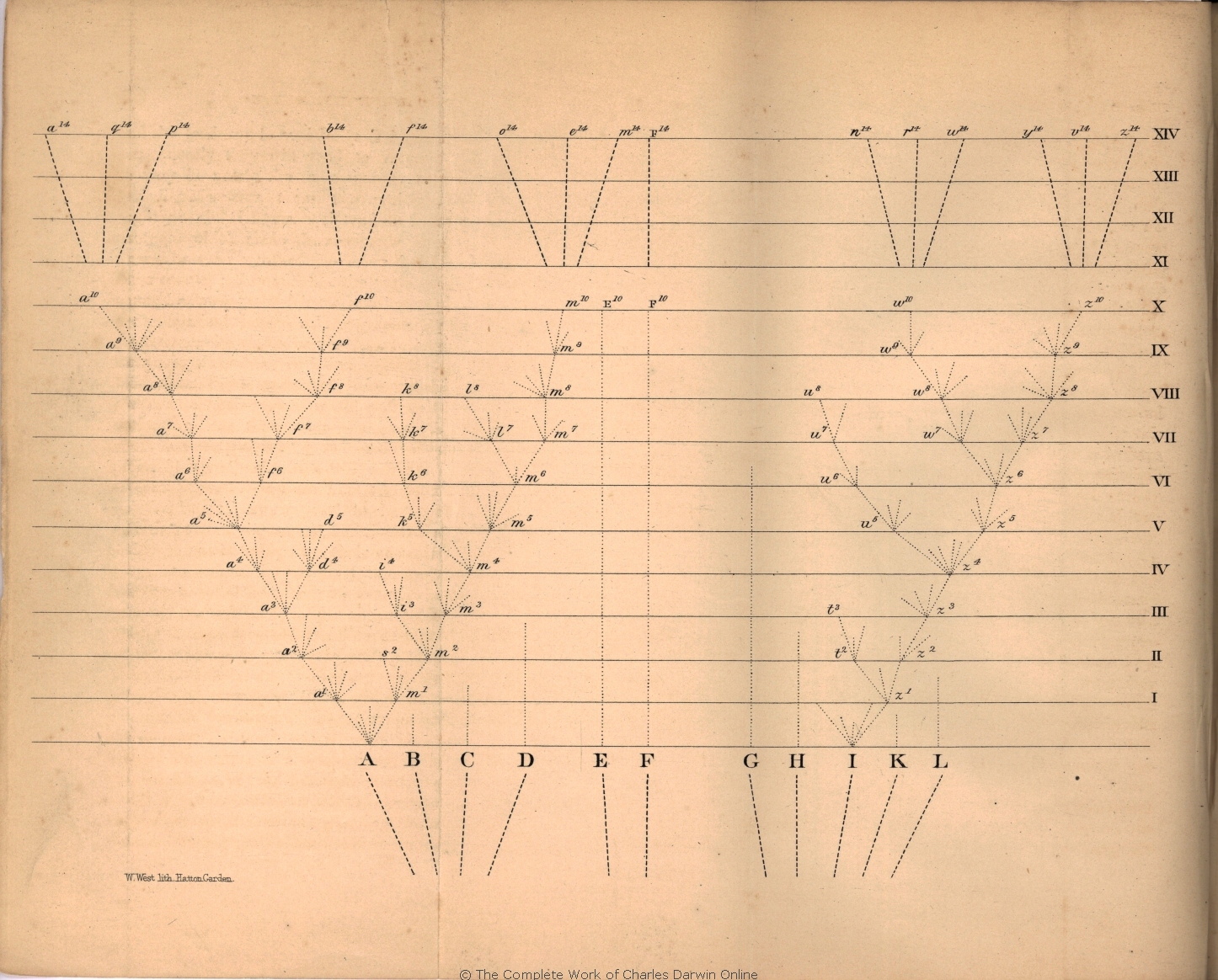
However it works out, it would be fitting if two different camps researching "role ecologies" were to find themselves at a loss to cross-fertilize. For as we celebrate the extended 200th birthday of Charles Darwin, author of "On the Origin of Species," let us note that one of the most practical definitions of a species is this: a population of organisms that can create offspring with their cohorts but not with anyone else. In other words, once a species comes to exist, never again will it cross-fertilize with other species. The result is Darwin's famous "Tree of Life," the one and only figure in his most famous book:
As I learned while reading Darwin's 200th essays in the NY Times last week, the one-way branching of this tree -- the permanent disabling of cross-fertilizing -- seems to be closely related to the same genetic mechanisms that protect a species from disease. (Intrepid cross-fertilizers should compare this to Ron Burt's notes on network closure.)

A "tree" is also a very specific kind of network, described very nicely in a recent paper by Skye Bender-deMoll on SNA & human rights. For those still celebrating Darwin's birthday, Bender-deMoll's definition is deliciously ironic: "Trees are hierarchies.... Pure trees are not found very often in naturally-occurring networks, but they are frequently used in classification systems or any situation where a strict hierarchy is imposed." Purposeful classification & hierarchy... just the things that Darwin so controversially discarded from the ecological world-view when he theorized the purposelessness of natural selection.

This work is licensed under a Creative Commons Attribution-ShareAlike 3.0 License and is copyrighted (c) 2009 by Connective Associates LLC except where otherwise noted.

Thursday, February 19, 2009

Six ways to make Web 2.0 work: Hoppe vs McKinsey

Nat Welch brought to my attention "Six ways to make Web 2.0 work" in the McKinsey Quarterly of Feb 2009.

Here are the six ways (quoted verbatim):
  1. The transformation to a bottom-up culture needs help from the top
  2. The best uses come from users -- but they need help to scale
  3. What's in the workflow is what gets used
  4. Appeal to the particpants' egos and needs -- not just their wallets
  5. The right solution comes from the right participants
  6. Balance the top-down and self-management of risk
Maybe it's because I am jealous of the clout wielded by McKinsey, but I do find the above list awfully repetitive. Someone please help me understand the important distinctions between numbers 1, 2, 5, and 6. I'll give the benefit of the doubt to 3 & 4 for being not repeats of 1, 2, 5, 6.

In preparation for an upcoming Web 2.0 panel discussion hosted by the Boston Club, I made my own list--with inspiration & edits from Nat W.

Bruce's Technology Tips

Focus on your business goals and let those drive your technology strategy. For example, consider the following goals:
  • Sales
  • Marketing
  • Recruiting
  • Talent management
  • Business development
  • Innovation of core products & services
Each one of those goals implies a different technology strategy, so it's important to know which goals matter as a basis for evaluating which technologies are helpful.

Web 2.0 Strategy Map

Technology for business is largely about storing, finding, synthesizing, and communicating information. Think about how these different tasks relate to your specific business goals. The table below summarizes how some Web 2.0 technologies relate to finding and synthesizing information:

This work is licensed under a Creative Commons Attribution-ShareAlike 3.0 License and is copyrighted (c) 2009 by Connective Associates LLC except where otherwise noted.

Wednesday, February 11, 2009

Ethics, Social Networks, and Web 2.0

Earlier this week the Human Resource Planning Society hosted a convention on Social Networks and Web 2.0. Nat Welch (CFAR) and I co-led a session on "Organizational Barriers and Web 2.0: Don't just sit there; find something." Afterward we were part of a panel discussion on ethics, social networks, and Web 2.0.

Somewhere there is a joke to be written about the time when a lawyer, a computational sociologist, and a human resource director all answer questions from St. Peter about ethics. Playing the straight man in the joke, my conversation with St. Peter will be a discussion about informed consent. Do people in my life know what they are getting into, and can they exercise choice based on that knowledge?

In many ways, the "informed" part is far slipperier than the "consensual" part of this combination (e.g., dating). And so it is with social network surveys. Years ago I read Borgatti and Molina's framework for ethics and SNA, and their paper has been a trusted compass of mine ever since. Mostly, it reminds me to respect the privacy of my clients and their employees (i.e., to offer them informed consent). Based my experiences since then, I have made the following chart that summarizes how privacy and informed consent are so problematic in a network context:

Lack of Privacy in Network Surveys


Traditional survey

Network survey

Questions:

1st-person vs.
3rd-person

Each individual reports information about himself.

Each individual reports information about others by name.

Results:

averages
vs.
specifics

Responses are aggregated so that individual respondents and non-respondents cannot be distinguished.

The presentation of results reveals specific responses attributed to specific individuals.

Visibility:

informed consent
vs.
leap of faith

Survey results allow each individual to compare himself silently with the group average. Each individual can then decide what to share about himself with whom.

Survey results expose how each individual is seen by others. Each individual has no ability to preview what others have said about him before it is published.


For me the insight of the above chart is the separation of all three rows. Each of the them can be considered as an independent risk factor with its own unique set of mitigation strategies.

All the LinkedIns and Facebooks of the world are tackling these three issues head-on (and surely more that I have not thought of).

As for social network surveys, I am not aware of one that allows truly informed consent: the ability to preview what others say about you before consenting to publication of that information. Perhaps my readers can enlighten me.

This work is licensed under a Creative Commons Attribution-ShareAlike 3.0 License and is copyrighted (c) 2009 by Connective Associates LLC except where otherwise noted.

Thursday, February 05, 2009

Lincoln and Darwin on Networks and Web 2.0

"Online social tools are great weapons for world peace and unity."
--Overheard at a discussion about LinkedIn, Blogs, and Twitter.

How appropriate that peace and unity cross my desk as we approach the 200th birthdays of Abraham Lincoln and Charles Darwin. Their historically coincidental births (12 Feb '09) and monumental legacies were brought to my attention by the latest cover of Smithsonian magazine, an issue I highly recommend.

Each of these great men speaks to the ages in a way that changes from era to era and from person to person. For me now, Lincoln shrewdly speaks of our sacred devotion to Liberty and equality as he leads the bloodiest war in American history:
"Four score and seven years ago our fathers brought forth on this continent, a new nation, conceived in Liberty, and dedicated to the proposition that all men are created equal. Now we are engaged in a great civil war, testing whether that nation, or any nation so conceived and so dedicated, can long endure." (Read on.)
Meanwhile, in one of the greatest discoveries of science, Darwin writes about the consequences of the simple truth that no one is created equal:
"As many more individuals of each species are born than can possibly survive; and as, consequently, there is a frequently recurrent struggle for existence, it follows that any being, if it vary however slightly in any manner profitable to itself, under the complex and sometimes varying conditions of life, will have a better chance of surviving, and thus be naturally selected. From the strong principle of inheritance, any selected variety will tend to propagate its new and modified form." (Read on.)
Darwin writes reluctantly, forced by outside events into a public announcement of his work, which he kept secret for many years in part to avoid the backlash he knew it would generate.

That backlash remains strong (at least in America), resulting in notions like intelligent design. Personally, I find intelligent design to be an absurd bastardization that dishonors both science and religion. And yet paradoxically I am continually tempted to take on the role of intelligent designer--pronouncing truths from the digital scriptures. I guess that's easier than emulating Lincoln or Darwin.

This work is licensed under a Creative Commons Attribution-ShareAlike 3.0 License and is copyrighted (c) 2009 by Connective Associates LLC except where otherwise noted.

Wednesday, January 21, 2009

In praise of editing

Thank you to everyone who commented on the Working Wikily thread. Comments on this blog are rare (which is probably to be expected) and 99% of them are complaints about kitchen appliances (which is agonizingly hilarious), and so it is a wonderful surprise to receive comments about a topic of ongoing interest to me.

A blizzard of holiday celebrations have passed since then, so to recap: In my Working Wikily series of posts, I spoke to the healthy priorities of those who do not write and publish on wikis and merely use information shared by others. This seemed to provoke violent agreement.

During the holiday season, I thought a great deal about those who do write and publish. The contemplation was entirely self-serving: Claire Reinelt and I spent those months slavishly editing our paper, "SNA and Evaluation of Leadership Networks."

We are optimistic that the result will be accepted for publication in Leadership Quarterly (LQ), and hopeful that LQ will allow us to share the manuscript before its estimated publishing date in 2010. You'll see it here first, if/when LQ does allow us to share it.

Most germane to this post, Claire and I are incredibly grateful to the anonymous reviewers of LQ. Their extremely pointed criticisms and their constructive suggestions for improvements enabled Claire and me to improve our originally submitted draft into something exponentially better. The extra time also gave Claire a chance to convince me to read Skye Bender-deMoll's overview of SNA. Again, I am grateful.

In my networked world, I very rarely encounter editorial demands as stringent as those imposed by an old-school academic peer-reviewed printed-on-paper journal. What an invaluable experience this has been.

More often in a networked world, editorial demands are sub-consciously self-imposed. Every day, it gets easier to avoid those with a different point of view and simply google our way to information that confirms what we already believed. That, at least, is what is suggested by this recent press release from the NSF, which I originally commented about here. Of course, the NSF only suggests that this phenomenon applies to the behavior scientists. Perhaps we non-scientists are more dedicated to the tireless pursuit of truth.

Certainly I credit Skye Bender-deMoll for scientific pursuit of truth. In this May 2008 paper, Skye presents the network Tree of Knowledge; then presents the Babel-izing confounding of terminology and lack of synthesis that characterize the field; and then suggests some editorial advice that is worth taking. For example:
"Although many people are advocating that network techniques will help a great deal with evaluation tasks, there have not been any large scale systematic studies comparing the various pilot projects. Most projects have been fairly small, both in sizes of networks and numbers of participants.

"The majority of projects appear to be doing more diagnosis than assessment. This may be partially because in most cases there is no “known standard” for comparing assessments. Also, researchers tend to be cautious because the data collection is not rigorous or comprehensive enough to be safely used for evaluation at this time.

"Although a few of the academic studies show high methodological maturity, much of the work still seems quite exploratory. In several papers the insight appears to come more from the in-depth interviews and data collection process, with the network analysis component serving as a parallel approach."
This work is licensed under a Creative Commons Attribution-ShareAlike 3.0 License and is copyrighted (c) 2009 by Connective Associates LLC except where otherwise noted.