Monday, May 29, 2006

Illumio finds experts among your friends

[Connectedness has taken a growing interest in the world of Web 2.0 and social commerce. Today's NY Times features a story about a new collaborative knowledge-sharing tool born from that technology:]

John Markoff writes in today's NY Times, "Software to look for experts among your friends." Tacit Software has introduced Illumio, which "represents the eBayification of organizations" according to Michael Schrage, a researcher at the Massachusetts Institute of Technology Sloan School of Management.

The article also claims, "Tacit's top achievement in its software for connecting people and expertise may be in a design that keeps personal information private." But the explanation of how Illumio does this "by using information stored on local computers" doesn't exactly strike me as reassuring.

For another take on the "ask my friends" space, see Yahoo Answers.

This work is licensed under a Creative Commons Attribution-ShareAlike 2.5 License and is copyrighted (c) 2006 by Connective Associates except where otherwise noted.

Tuesday, May 23, 2006

Pulitzer-prize-winning journalists tout SNA software

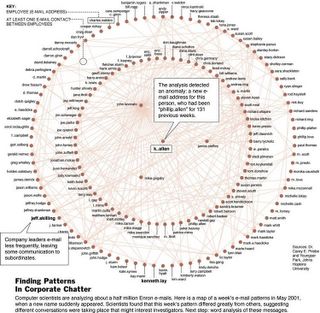
Bill Mitchell (@ Poynter Online) interviews four Washington Post reporters about their Pulitzer-Prize-winning techniques. James Grimaldi highlights Wikipedia and social network analysis as the two biggest revelations to his work that he intends to use more in the future. The use of SNA to cover government scandal has also been prominent at the NY Times, which published this full-page graphic a couple days ago (see also here and here):
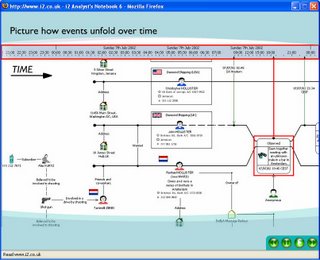
Back at the Post, Grimaldi specifically touts i2 Analyst's Notebook, a network-drawing package expressly designed for investigators. Below are a couple screen shots to whet your appetite:


This work is licensed under a Creative Commons Attribution-ShareAlike 2.5 License and is copyrighted (c) 2006 by Connective Associates except where otherwise noted.

Tuesday, May 16, 2006

The NSA's Math Problem

Thanks to Jim Murphy @ ODLG and Vicki Axelrod @ ONA-Prac for tipping me off to "The NSA's Math Problem," a nice NY Times Op-Ed piece which explains the futility of the NSA's massive SNA initiative (previously mentioned here). Simply put, there are too many phone calls unrelated to terrorist activity and too many terrorist relationships unexpressed by recent phone calls.

Op-Ed Author Jonathan David Farley (a mathematics fellow at Stanford Univeristy who specializes in counter-terrorism) suggests "concept analysis" as a more useful alternative. Valdis Krebs (also on ONA-Prac) points to Jeff Jonas' post about more specific focus on meaningful relationships to measure connections.

This work is licensed under a Creative Commons Attribution-ShareAlike 2.5 License and is copyrighted (c) 2006 by Connective Associates except where otherwise noted.

Monday, May 15, 2006

Scan this book! (Amazing NY Times piece on digitizing books)

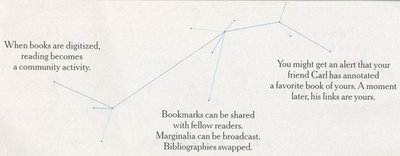
Sunday's NY Times Magazine cover story is a manifesto "Scan this book!" by Kevin Kelly, which explains (1) why books will be exponentially more useful once they are digitized, and (2) the ridiculous legal hurdles that prevent full-throttle industrial-scale digitizing from happening today.Judy Breck at Smart Mobs has posted a nice summary of the article.

If you want to put the power of the fully networked digitized library into your SNA research, then see also my Nov 2005 post on CiteSeer, where this technology is being used heavily every minute by the technical/academic community.

This work is licensed under a Creative Commons Attribution-ShareAlike 2.5 License and is copyrighted (c) 2006 by Connective Associates except where otherwise noted.
Saturday, May 13, 2006

NSA does SNA of the entire USA with massive phone call database

SNA by the NSA has been all over the week's headlines, kicked off by USA Today's story of May 11, 2006: "NSA has massive database of Americans' phone calls."

For more on security pros and cons of exhaustively trolling communication archives of countless innocent civilians in order to detect a few bad guys, see also:
And finally, see this surprisingly entertaining bit, "NSA data mining explained," from the NY Times, which includes this testament to American's lack of concern depsite all the headlines:
"An ABC News-Washington Post poll published Friday found that 63 percent of the 502 random Americans surveyed found the NSA's collection of phone call records either 'strongly' or 'somewhat acceptable.' In that same survey, 66 percent of the respondents said it wouldn't bother them if the NSA had possession of their call logs."
This work is licensed under a Creative Commons Attribution-ShareAlike 2.5 License and is copyrighted (c) 2006 by Connective Associates except where otherwise noted.
Thursday, May 11, 2006

Cornell launches "Getting Connected" computational social science initiative with $2M from NSF

Cornell University's multi-disciplinary Institute for Social Sciences recently launched its newest project, "Getting Connected: Social Science in the Age of Networks." Here is a press release from last fall, when the NSF gave them $2M to get started.

The press release explains how the project is "ultimately intended to assist in the detailed statistical and observational study of social and information networks" and how it "will involve a team of computer scientists and social scientists developing the means -- dubbed "cybertools" -- to extract and analyze information from vast collections of data."

The project is led by Michael Macy of the Dept of Sociology, but I am especially excited because Jon Kleinberg is on the team. I think it's no exaggeration to credit Jon (a professor of Computer Science) as the world's leading expert at distilling fundamental principles from huge piles of network data.

I hope other initiatives (e.g., the Network Roundtable) that are gathering their own organizational network databanks will pay close attention to developments emerging from "Getting Connected." By bringing together the energy from these separate initiatives, we will go far in developing SNA from its roots in research and evaluation into a solid, forward-looking, and prescriptive organizational tool for business and community.

(Thanks to Ted Welser, a soon-to-be Cornell sociology postdoc, for telling me about "Getting Connected" at Sunbelt.)

This work is licensed under a Creative Commons Attribution-ShareAlike 2.5 License and is copyrighted (c) 2006 by Connective Associates except where otherwise noted.
Tuesday, May 09, 2006

Network weaving blog by June Holley, Valdis Krebs, and Jack Ricchiuto

June Holley, Valdis Krebs, and Jack Ricchiuto have recently started a Network Weavers blog. (Thanks, Valdis, for alerting me; and a special shout out to Jim Murphy @ ODLG who got the news to me almost as fast as Valdis.)

Linking to fellow network weaving SNA practitioners is where I find my blog persona simultaneously at its most powerful and vulnerable.

Vulnerable, because I have met with hoped-for clients who have gushed, "You have a great blog, Bruce. Thanks for linking me to Valdis Krebs."

Powerful, because putting network weaving at the heart of my own business helps set an incredibly productive tone for all of my projects and, in my fondest hopes, contributes in some way to establishing a positive communal identity for all my fellow SNA practitioners.

For more on the somewhat counter-intuitive power of giving away referrals to the competition, see my reporting of last year's KM Cluster, where Steve Borgatti spoke very eloquently on the topic.

This work is licensed under a Creative Commons Attribution-ShareAlike 2.5 License and is copyrighted (c) 2006 by Connective Associates except where otherwise noted.